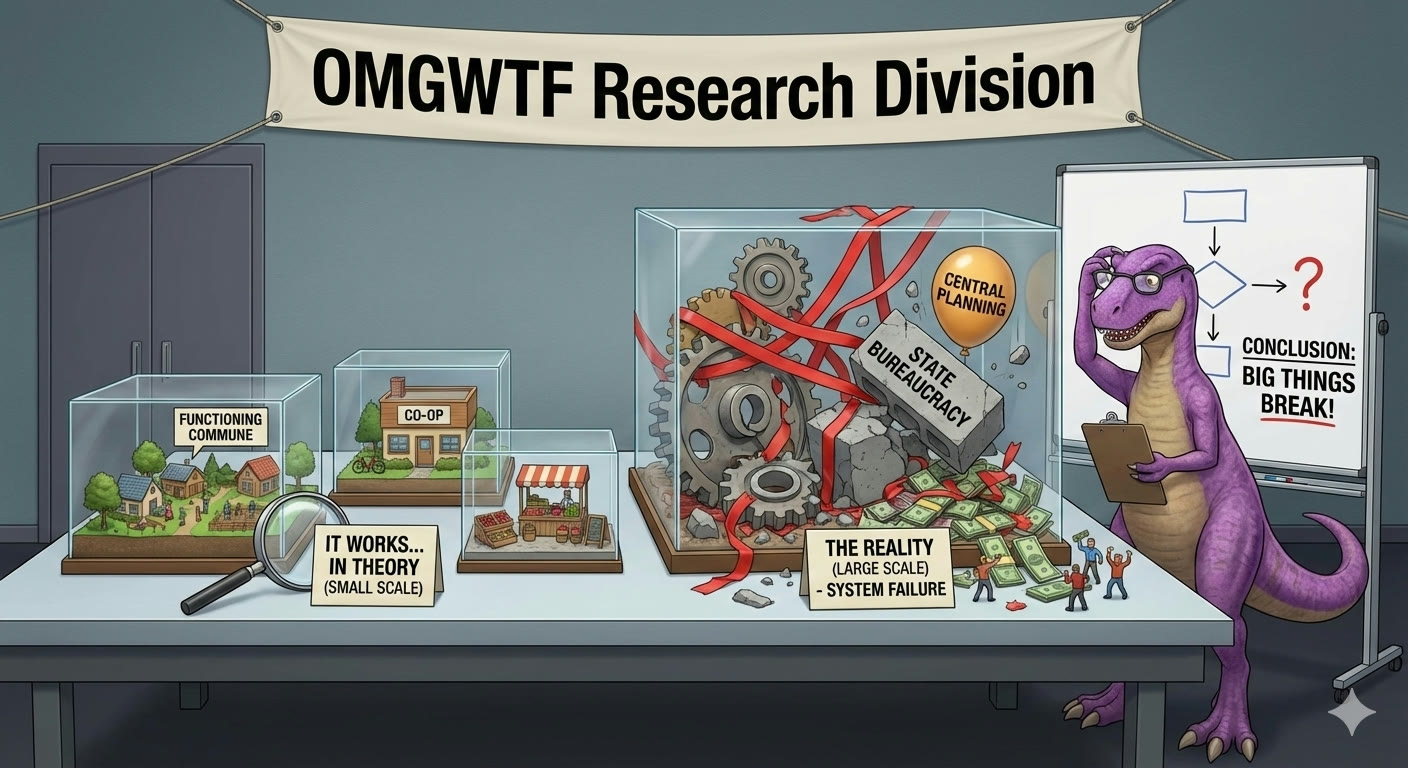
Why does communism work at home but fall apart at scale? Why does socialism thrive in communities but buckle under bureaucracy? Why does capitalism coordinate millions of strangers… and then eat itself? This piece breaks down The Scale Illusion — the overlooked reason every economic system works beautifully in the right context and fails spectacularly in the wrong one. Using real psychology, real economics, and unapologetic satire, we explain why humans argue ideology like religion, why your household is basically a tiny communist state, and why scale—not morality—is the thing everyone keeps ignoring.
—or—
Why Your Family Home Is Basically a Tiny Communist State and the Internet Needs to Calm Down
Before we start, a small apology.
We’re about to cover three topics people usually lose their minds over individually — communism, socialism, and capitalism — which means this one’s going to be a bit longer than our usual “scroll, snort, share” experience.
So grab yourself a glass of your favourite poison ☕🍷🥃, sit back, and give us about ten minutes while we calmly explain why:
Let’s get one thing out of the way early.
If you’ve ever argued about communism, socialism, or capitalism online, congratulations — you’ve participated in one of humanity’s least productive traditions.
Everyone is absolutely convinced their system would work perfectly…
👉 if only people behaved properly
👉 if only it was implemented correctly
👉 if only everyone else wasn’t an idiot
And to be fair?
They’re all right.
And they’re all wrong.
Not because the systems are evil.
Not because humans are broken.
But because scale matters, and almost nobody talks about it.
So we did.
Most economic arguments quietly assume something like this:
“If a system works in principle, it should work everywhere.”
That single assumption is doing a lot of damage.
Human societies don’t scale smoothly like software updates.
They don’t go from version 1.0 to 2.0 without issues.
They jump between entirely different coordination problems as they grow.
What works brilliantly for:
…often collapses spectacularly when you try to apply it to:
Same humans.
Completely different problems.
Yet we keep acting shocked when things fall apart.
This mismatch — between how big a system is and how it’s designed to work — is what we call:
And once you see it, you can’t unsee it.
Let’s start really small.
Your household.
Nobody invoices their partner for making tea.
Children don’t pay rent.
You don’t negotiate market rates for emotional support, childcare, or “can you hold this while I tie my shoe.”
No one’s standing in the kitchen shouting,
“Actually, I did 0.3 more dishes than you this week.”
Instead, most homes quietly run on a very old rule:
From each according to their ability, to each according to their need.
Congratulations.
That’s communism.
And — awkward pause — it works beautifully.
Why?
Because at small scale:
No bureaucracy.
No performance reviews.
No incentives spreadsheet.
No ideological manifesto taped to the fridge next to a takeaway menu.
Just humans doing human things — cooperating because they can see each other, depend on each other, and would feel deeply uncomfortable freeloading in front of people they care about.
At this scale, fairness is obvious, accountability is personal, and the system basically runs itself.
Which is why it works.
Now imagine a slightly larger group.
Not a household — but not a nation either.
Think:
People don’t know everyone intimately anymore, but:
This is where socialism often works best.
Shared ownership.
Managed redistribution.
Rules agreed by the group.
Still functional — but only while the group stays manageable.
Here’s the bit most arguments skip.
Humans have a rough cognitive limit on how many stable social relationships we can maintain.
It’s known as Dunbar’s Number, and it sits somewhere around 150 people.
Below that number:
Above it?
Things start getting weird.
Once the group grows too large:
Suddenly you need:
And the moment you need rules about rules, you’re no longer relying on trust — you’re relying on structure.
That’s not a moral failure.
That’s a scale problem.
Socialism doesn’t break because people stop caring.
It breaks because brains have limits, and groups outgrow what informal cooperation can handle.
And now things start getting… spicy.
Now scale up again.
Not dozens.
Not hundreds.
Millions of people.
Nobody knows anyone.
There’s no shared identity.
No common norms.
No reason to trust the person on the other side of the transaction.
Trust? Gone.
Visibility? Gone.
Social pressure? Good luck.
This is where capitalism actually shines.
Markets don’t need trust.
They don’t need shared values.
They don’t even need people to like each other.
They just need:
That’s it.
Price signals act like a giant, decentralised communication system, quietly coordinating behaviour across enormous populations. You don’t need to know who grew your food, built your phone, or shipped your parcel. You just respond to prices, availability, and incentives — and so does everyone else.
Somehow, this allows millions of strangers who will never meet, never agree, and often actively dislike each other to still:
That’s not evil.
That’s astonishing.
But — and this matters — the same incentive-driven machinery that makes capitalism scale so well also creates its own problems. When optimisation becomes the goal, things like inequality, short-term thinking, and rule-gaming aren’t bugs — they’re predictable side effects.
Capitalism doesn’t fail because it’s immoral.
It struggles because incentives don’t care about long-term social cohesion unless you force them to.
Which brings us to the part everyone argues about…
Everywhere people pretend one system should work at every scale.
That’s the mistake.
Each system is built to solve a specific coordination problem.
Apply it outside that range, and it starts doing exactly what it was never designed to do.
Systems built on shared obligation and visibility stop working when contributions disappear into the crowd. Once people believe their individual effort doesn’t matter, cooperation turns optional — and resentment fills the gap.
What begins as organised fairness slowly turns into rule-management, oversight layers, and endless negotiation. The system doesn’t fail because people stop caring — it fails because caring doesn’t scale cleanly.
When success is measured narrowly, behaviour follows the metric — even if the outcome damages the system itself. Capitalism doesn’t collapse from greed; it frays when incentives drift away from collective resilience.
None of these failures are surprising.
They’re not moral flaws.
They’re not ideological betrayals.
They’re structural consequences of scale.
Here’s the psychological twist most debates never reach.
Economic systems don’t just organise resources.
They organise meaning.
They offer simple stories about:
Over time, people attach more than logic to these systems. They attach:
So when you criticise the system, what they don’t hear is a technical argument.
What they hear is:
“You are wrong.”
“Your values are wrong.”
“You are a bad person.”
At that point, evidence stops being information and starts being a threat.
You’re no longer discussing economics.
You’re threatening someone’s sense of self.
That’s why debates escalate instead of resolve.
That’s why people defend systems that are clearly failing in certain contexts.
That’s why no one ever concedes — because conceding feels like a moral loss, not an intellectual one.
And that’s why the internet feels permanently exhausted.
There is no perfect system.
There never has been.
There are only:
That’s it.
The question we should be asking isn’t:
“Which ideology is correct?”
It’s:
“What coordination problem are we actually trying to solve?”
Because different problems need different tools.
Families need trust.
Communities need norms.
Nations need incentives.
Forcing one system to do everything — everywhere — isn’t principled.
It’s how systems fail.
Over and over again.
And until we stop arguing ideology and start talking scale, we’ll keep having the same fights — just louder, angrier, and with progressively worse memes.
The point isn’t to pick a side.
The point is to stop acting surprised when:
These aren’t moral failures.
They’re not betrayals of “true” ideology.
They’re scale failures.
And until we’re honest about scale — about human limits, trust, incentives, and coordination — we’ll keep recycling the same arguments forever.
Same systems.
Same outrage.
Same certainty.
Just louder, angrier, and somehow still convinced this time it’ll be different.
This blog is the friendly, slightly sarcastic version.
If you want the actual research — citations, theory, and the full interdisciplinary framework — you can read the complete paper here:
👉 The Scale Illusion: Why Communism, Socialism, and Capitalism All Work—Until They Don’t
https://omgwtf.ltd/the-scale-illusion
Or, if you hate yourself just enough:
📧 hello@omgwtf.ltd for the full PDF with appendices.